

Introduction
Nearly 2.5 million businesses run at least part of their operations through AT&T. Wireless. Fiber. Networking. Security. Often all four stacked together at once. That scale’s exactly why the question matters here. Can one provider actually deliver everything a growing business needs? Or does breadth like that come at the cost of focus?
This review gets into AT&T Business as a full connectivity partner rather than picking apart one product in isolation. Fiber, networking, cybersecurity, support, and where a competitor might genuinely serve a business better instead.
Explore AT&T Business Solutions
Key Benefits of AT&T Business
Nationwide connectivity backed by real fiber infrastructure. Business Fiber, up to 5 Gig in supported areas, no data caps, no equipment fees tacked on. Enterprise networking too, scales from a five-person office up through a multi-location operation without much drama. Advanced cybersecurity, including newer network-embedded protection extended down to smaller businesses. Solutions built to grow alongside a company rather than requiring a total platform switch later.
About AT&T Business
Company Overview
AT&T’s roots go back over 140 years, though the current business services division looks nothing like the old phone company most people picture. It’s now one of the largest enterprise telecom and technology providers in the country, wireless, fiber, cloud connectivity, and managed security all under one roof.
Who AT&T Business Is Best For
Small businesses wanting reliable, no-nonsense connectivity fit here well. So do multi-location operations juggling several offices at once. Distributed and hybrid workforces benefit too, and larger enterprises needing serious networking depth find a real home in the upper tiers of AT&T’s catalog.
Business Solutions & Connectivity
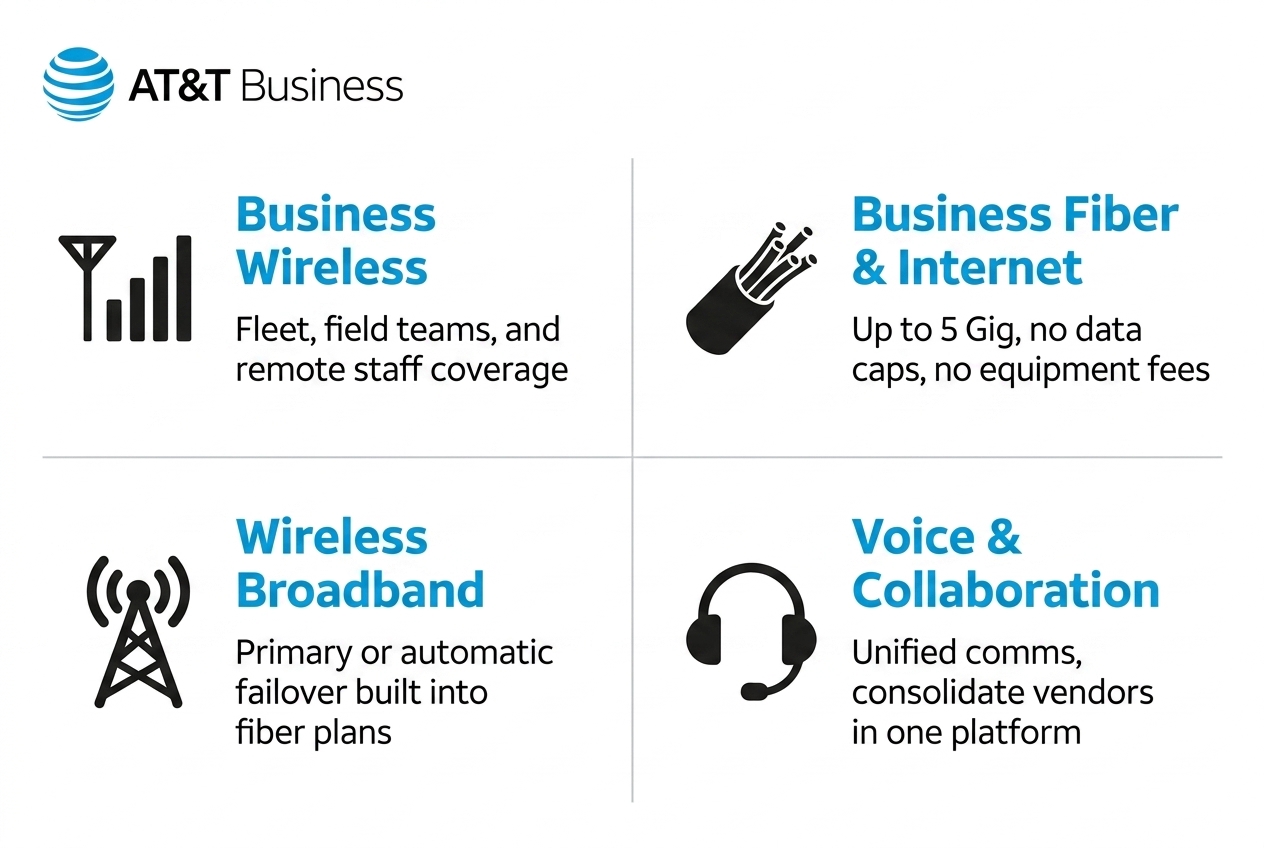
Business Wireless
Mobile plans built around fleets, field teams, and remote staff who need reliable coverage away from a fixed office. Device management tools come bundled in for larger deployments too.
Business Fiber & Dedicated Internet
Business Fiber tops out around 5 Gig in supported areas, no annual contract, no data caps. Dedicated Internet steps up from there, symmetrical speeds and guaranteed bandwidth for operations where downtime just isn’t an option.
Wireless Broadband
Useful as a primary connection somewhere fiber hasn’t landed yet, or as backup. Actually, AT&T bundles automatic 5G failover into qualifying Business Fiber plans now, at no extra charge, so wireless isn’t just a fallback plan anymore, it’s built into the main product.
Voice & Collaboration Solutions
Business phone systems and unified communications tools round out the lineup, useful for anyone consolidating vendors instead of juggling a separate provider for calls alone.
Compare AT&T Business Connectivity Options
Enterprise Features & Technology Services
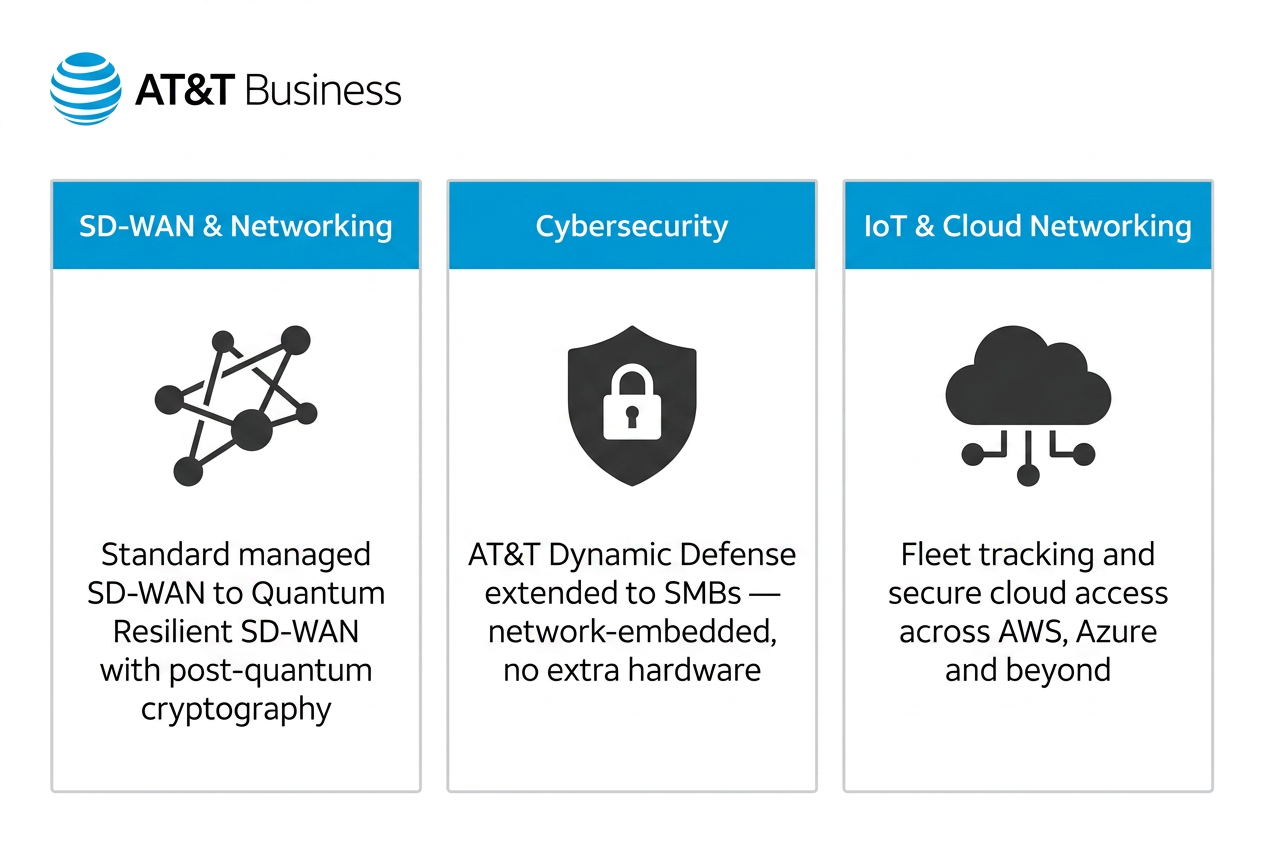
Networking gets real attention here, not just an afterthought bolted onto internet service. SD-WAN options range from standard managed deployments up to something genuinely new, a Quantum Resilient SD-WAN built with Cisco that layers in post-quantum cryptography. AT&T’s positioning this as a first for a major North American provider, worth knowing about if long-term data security is actually a board-level concern.
Cybersecurity used to be an enterprise-only conversation at AT&T. That’s shifted. AT&T Dynamic Defense, previously reserved for larger accounts, now extends network-embedded protection to smaller Business Fiber customers too, no extra hardware required. IoT connectivity supports fleet tracking and connected devices at scale, and cloud networking ties secure access back to whatever environment a business actually runs on, AWS, Azure, or otherwise.
Network Performance & Reliability
Wireless Coverage
Broad nationwide coverage, competitive with the other major national carriers, though rural pockets can still vary the way they do industry-wide.
Fiber Availability
This is the one to check carefully before assuming anything. AT&T’s pushing its fiber footprint out aggressively right now. Denver, Phoenix, Seattle, metros that weren’t well covered before, recent moves are landing there specifically. Still depends entirely on the exact address though. Never assume. Always check first.
Business Network Reliability
AT&T backs Business Fiber with a 99.9% reliability guarantee. Credits kick in too, if downtime crosses 20 minutes. Real commitment, that, not just marketing copy sitting on a page somewhere.
Supporting Remote & Hybrid Workforces
Wireless, fiber, automatic failover between the two, that combination keeps distributed teams connected pretty reliably. Nobody’s stitching together three different vendors just to keep remote staff online.
Customer Support & Business Scalability
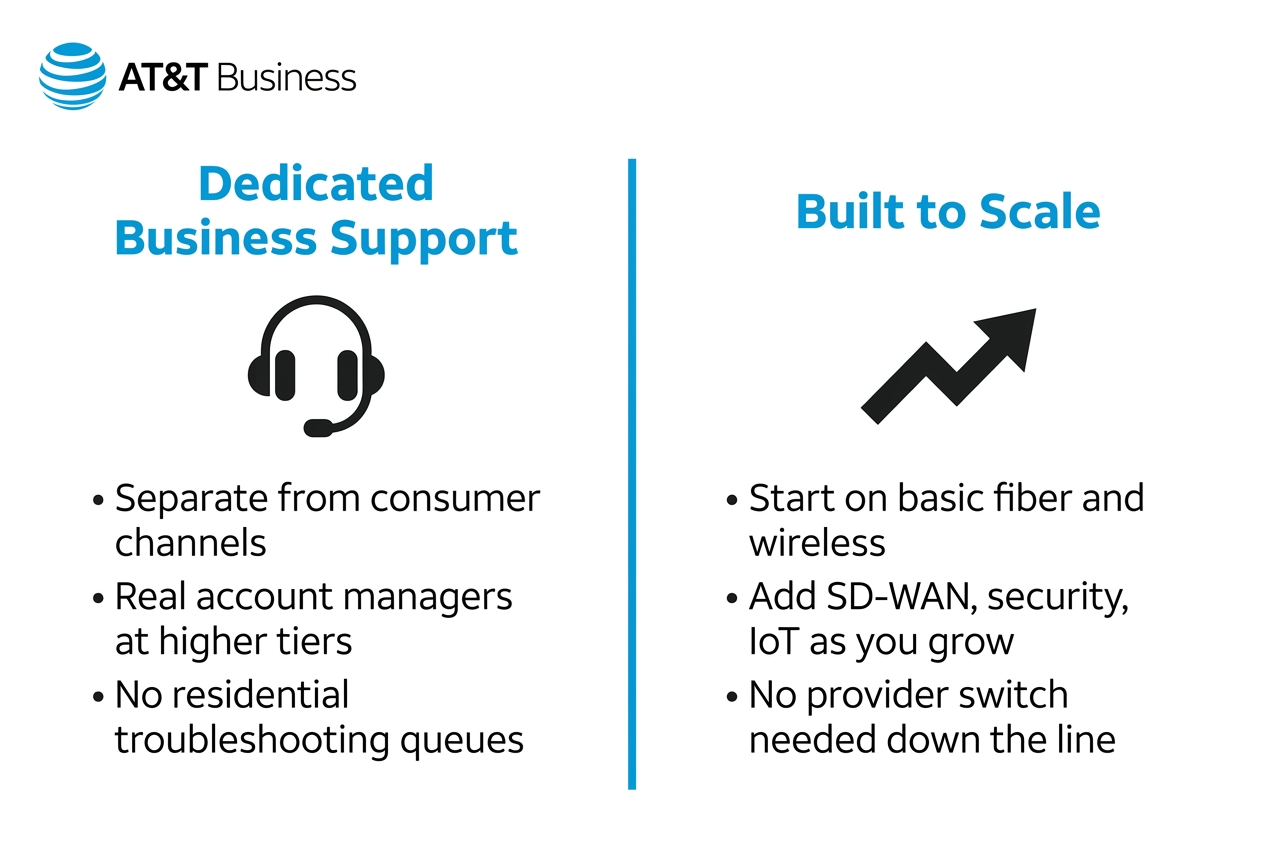
Dedicated business support exists separately from AT&T’s consumer channels, which matters more than it sounds, nobody wants to get routed through a residential troubleshooting script for an enterprise networking issue. Account management improves noticeably at higher tiers too, larger accounts get a real point of contact instead of a rotating queue. And scaling up works the way it should here. A five-person shop can start on basic fiber and wireless, then layer in SD-WAN, managed security, and IoT as the business actually grows into needing them, without switching providers entirely down the line.
Pros and Cons
| Pros | Cons |
|---|---|
| Broad enterprise connectivity portfolio | Fiber availability varies by location |
| Strong networking and security capabilities | Enterprise solutions can become complex |
| Business Fiber and Dedicated Internet options | Pricing often requires custom quotes |
| Comprehensive managed services | Some advanced deployments require consultation |
AT&T Business vs Verizon Business
| Factor | AT&T Business | Verizon Business |
|---|---|---|
| Wireless Coverage | Strong nationwide, competitive rural reach | Strong nationwide, often edges ahead in rural areas |
| Business Internet | Broad fiber and dedicated options | Strong fiber presence, particularly in the Northeast |
| Fiber Availability | Expanding aggressively into new metros | Long-established in core East Coast markets |
| Enterprise Networking | Deep SD-WAN portfolio, newer post-quantum option | Comparable SD-WAN and managed networking depth |
| Cybersecurity | Dynamic Defense now extending to SMBs | Strong managed security, enterprise-focused historically |
| Best For | Businesses wanting fiber-forward growth with bundled security | Businesses prioritizing wireless reliability and East Coast fiber depth |
Both carriers compete closely at the enterprise level, genuinely comparable in most core categories. AT&T’s edge right now is really the fiber expansion combined with security that’s trickling down to smaller accounts. Verizon still holds strong footing in wireless reliability and its established East Coast fiber base. Neither wins outright, it comes down to region and which piece of the stack matters more to a specific business.
Is AT&T Business Worth It?
Growing businesses planning to add locations, employees, or connected devices over the next few years tend to get real value from AT&T’s scalable structure. Businesses in newly expanded fiber metros benefit particularly, catching AT&T at a genuine growth phase in their own network buildout.
Businesses in fiber-limited areas, or ones wanting simple, predictable flat pricing without a custom quote process, might find the experience more frustrating than it needs to be. The long-term value is real for anyone planning to grow into the platform, less so for a business that just wants basic internet and nothing else.
Frequently Asked Questions
Is AT&T Business suitable for small businesses?
Yes, genuinely. Fiber and wireless plans scale down to a single-location small business just as well as they scale up.
What internet solutions does AT&T Business offer?
Business Fiber up to 5 Gig, Dedicated Internet for guaranteed bandwidth, and wireless broadband as backup or primary depending on availability.
Does AT&T Business provide managed networking services?
Yes, SD-WAN, Ethernet, and managed networking are core parts of the enterprise catalog, including a newer post-quantum SD-WAN option.
How does AT&T Business compare with Verizon Business?
Closely matched overall. AT&T leans into fiber expansion and bundled security, Verizon holds a strong wireless and East Coast fiber position.
Can AT&T Business support enterprise growth?
Yes, the whole structure’s built around that, adding networking, security, and IoT layers as a business scales up over time.
Final Verdict
Growing businesses, multi-location operations, and anyone wanting connectivity and security bundled under one long-term partner tend to find real value in AT&T Business. The recent push into new fiber markets and the extension of enterprise-grade security down to smaller accounts both point toward a provider actively investing rather than coasting.
Businesses outside AT&T’s stronger fiber regions, or those wanting simple flat-rate pricing without a sales conversation, may find a different provider fits better day to day. For a business planning real growth over the next several years though, AT&T Business holds up as a legitimate long-term connectivity partner.